Well, that bittersweet day has come and gone once again. Our last Monarch butterfly for this season emerged last week. A beautiful female…and now she is on her way! 🙂
Did you know that the last generation of Monarch butterflies for a season is called the “Methuselah generation”? They are the “super generation” since they are the ones that will migrate all the way to Mexico for the winter. They might fly up to 3,000 miles!! That’s hard to believe! This generation of Monarchs actually live longer than the other generations. They also will not develop reproductively until next spring. In the spring, they will finish developing and mate and then the cycle starts all over again. 🙂
I always enjoy helping the Monarch butterflies to survive while they are with us and to help keep them from becoming extinct. You can also help them by planting milkweed seeds in the fall! Monarchs are amazing and beautiful creatures! I hope you’ve enjoyed your peek into their lives through my blog. 🙂
Hello again! 🙂 Sorry I’ve been away from my blog a lot this summer! It’s good to be back! I think it’s way past time to give you an update on our Monarch butterfly raising this year. It’s been a pretty good year for us. In previous posts, I showed you the teeny tiny Monarch butterfly eggs and then the tiny caterpillars and then how they were growing. We were able to raise and release 25 butterflies inside our home in their private little “hotels”. Yay! Here’s a few pictures of butterflies that emerged from that bunch of caterpillars.
This one is still hanging on the empty chrysalis that it emerged from. Isn’t that amazing?! How did that butterfly fit inside there? Wow, isn’t nature impressive?!
Here is one butterfly being released into the wild.
This one was taking a rest on some Swamp Milkweed.
Here’s another one checking out our orange Coneflowers.
One more picture of a butterfly almost ready to take flight from these Black-eyed Susan flowers.
After the first 25 butterflies were raised and flew off on their own, we started finding new eggs and caterpillars. But it was almost time for us to be gone for most of 2 weeks so I didn’t bring any caterpillars inside since I wouldn’t be home to care for them. BUT they did a great job on their own! 🙂
Our milkweed plants were literally crawling with Monarch caterpillars! Check this out…there are at least 4 of them in this picture!
Here’s some more! They look like little fat sausages, don’t they? 😉
We came home to find their chrysalis all over the place outside our house! Under the edge of the deck…
On the stairs…
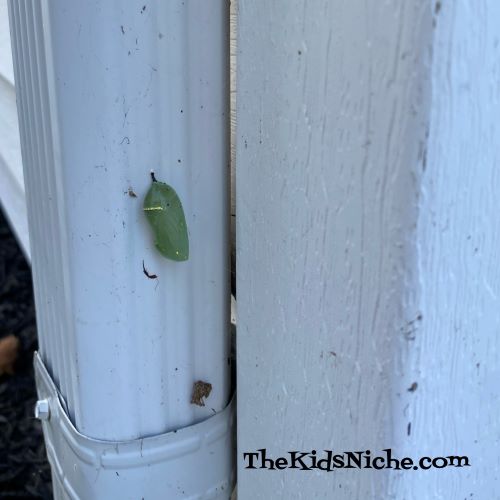
On the downspout…
On the siding on our house…can you find 3 in this picture?
And 2 on the handrailing on the deck…
Altogether we found 22 chrysalis! Wow! Now look what is happening… 😉
Yep, the butterflies are starting to emerge! 🙂 So far, 4 of them have emerged and flown away. But wait! There was one more surprise today!! 🙂 While I was outside checking the chrysalis this afternoon, I found this!
Ha! 4 more “little fat sausages”! They were on a milkweed plant that is almost done for this year, so I brought them inside to a “hotel” so I can keep them supplied with fresh milkweed until they go into their chrysalis too. 🙂
Raising and helping to preserve Monarch butterflies is such a fun project for kids AND adults! Maybe you can grow some milkweed plants too and you just might be visited by some beautiful Monarch butterflies! 🙂
Greetings, butterfly lovers! I don’t have much time for blogging today (company is coming!) but I wanted to give you a quick update on the Monarch caterpillars I showed you. Remember these tiny guys?
I took that picture 5 days ago, but here is a picture I took just this morning. Do they look different to you?
Wow! They grow so fast that it’s hard to believe! 🙂 They are still quite little, but are you surprised at how much bigger they are? It’s so fun watching them grow! 🙂 Check back later for more Monarch caterpillar updates!
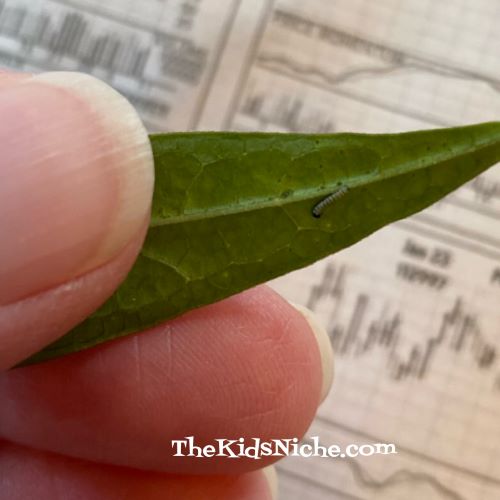
I’m so excited to tell you that we are now finding Monarch butterfly eggs and caterpillars on our milkweed plants! 🙂 Each year for several years now, I try to help the endangered Monarch caterpillars survive until they turn into butterflies and then I release them back into the wild. It’s sooo interesting and fun! Monarch caterpillars will only eat the milkweed plant, so that is where you will find their eggs and caterpillars. They are just now starting to show up here in our part of Ohio. I currently have 14 teeny tiny caterpillars and they can be pretty sneaky and a bit hard to keep track of since they are so tiny! Here’s a close-up picture of one…notice how small it is in comparison to my thumb and finger.
Now let’s test out your powers of observation. Can you find 4 caterpillars in this picture?
There is one caterpillar on each piece of the milkweed leaves. In case you are having trouble seeing them, here’s a bigger picture.
I bet you found them all now! 🙂 Can you believe how small they are?? Wow! Remember that I said they can be sneaky little guys? Look at this guy I caught escaping from his “hotel”!
Luckily I saw him before he got any farther and I offered him a fresh piece of milkweed and he decided he liked that and crawled aboard. I put him safely back in his hotel. 😉
Stay tuned for more Monarch caterpillar updates coming soon! 🙂
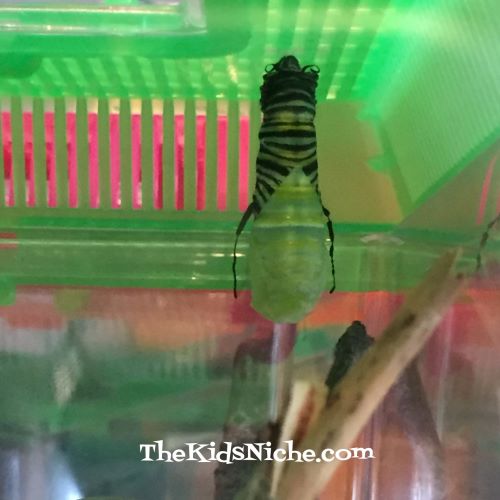
Hello and welcome to another adventure in the life cycle of the Monarch butterfly! Yesterday we looked at how the Monarch caterpillar changes into its chrysalis. Today we’ll see what happens when it’s time for the butterfly to emerge from the chrysalis. (Hang on until the end of this post for a video!) So just to remind you, here’s what the Monarch butterfly’s chrysalis looks like.
When the time for the butterfly to emerge is getting close, the chrysalis will start to turn a darker color and look black. Notice in this picture that one chrysalis looks green but the one in the background is black.
Here is a closer look.
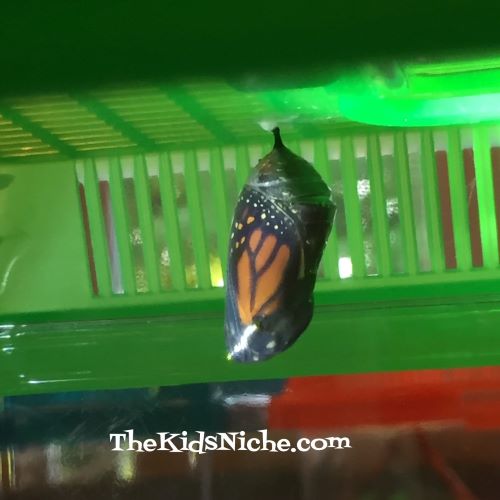
Did you notice that you can see the butterfly’s wing inside the chrysalis? My pictures aren’t super clear because they are taken looking through the plastic container, but here is a picture taken with a flashlight shining on the chrysalis.
Whoa!! How cool is that?! The chrysalis is now very thin and you can see the butterfly! Next, the chrysalis starts to slowly open. Can you see along the left hand side that the chrysalis is splitting open?
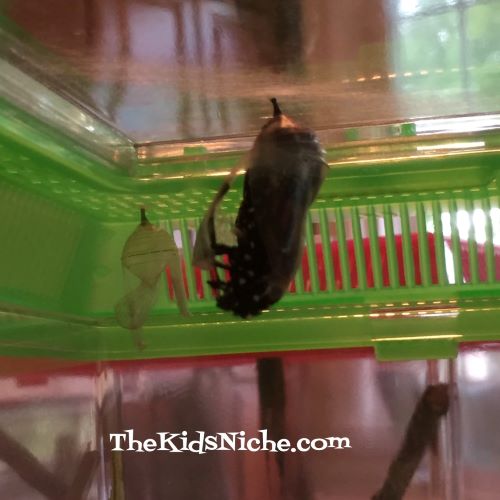
Then the split becomes a little wider. The butterfly is hanging upside down right now and you can start to see its head coming out first.
The butterfly is dropping down a little lower now. You can start to see its legs that are folded up close to its head.
It’s now beginning to slide out of the chrysalis!
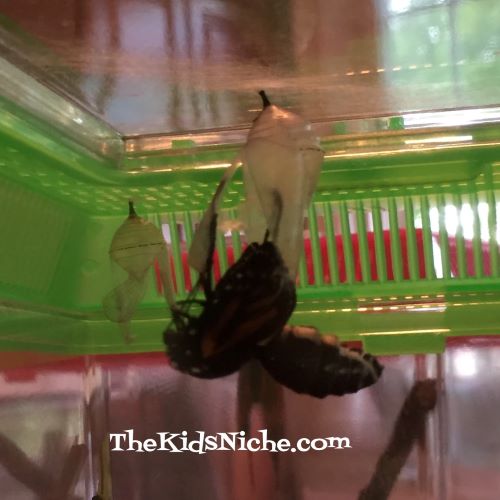
Sliding farther out…almost there! The chrysalis will stay attached to the top of the container as the butterfly slides down and out of it.
And it’s out! Look how big it’s body looks right now and how small and folded up it’s wings are.
The butterfly grabs a hold of the empty chrysalis and it will hang right side up now.
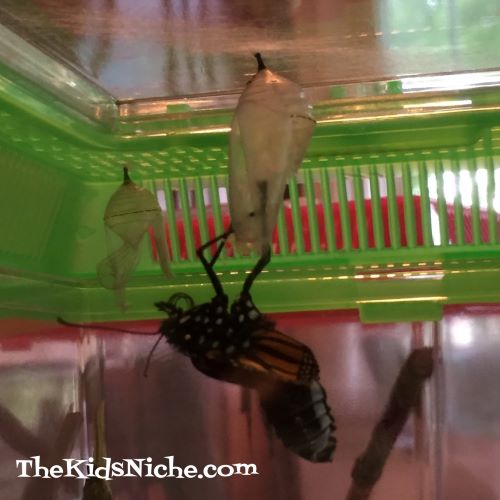
As the butterfly hangs on the empty chrysalis, it will pump fluid from its abdomen into its wings and the wings will begin to expand and the body will become smaller. This next picture was taken 5 minutes after the butterfly emerged or eclosed. Its wings are still wrinkled looking.
Then 10 minutes…it’s wings are looking straighter.
And then here is 15 minutes after emerging.
It takes a couple of hours for the butterfly to finish this process and for it’s wings to expand and dry off. They don’t need to eat right away so it’s good to give them time to dry off and to begin to flex their wings. After a few hours have passed, I carefully open the container and put my hand close to the butterfly and they usually climb onto my finger. And then it’s time to set them free outside.
Here is a video I took of the process of the butterfly emerging from it’s chrysalis. It is so amazing to watch this happen!
It has been such a rewarding experience for me to help these beautiful creatures along in their transformation from a tiny little egg into an amazing gorgeous butterfly! This is my fourth year of raising and releasing Monarchs and I hope I can continue to do so for many years to come! I hope you have enjoyed coming along with me on this journey! 🙂
I’m back to tell you some more about what happens when a Monarch caterpillar goes into its chrysalis in the next stage toward becoming a butterfly. When the caterpillar is fully grown, it stops eating and finds a place to hang upside down. It attaches itself to the top of the hotel or a stick if its still in nature. It looks like the letter “J” when it hangs.
This next picture shows 3 different caterpillars in the different stages of going into a chrysalis.
The caterpillars hang in the letter J form for a day or so and then something amazing starts happening. They straighten their bodies out just a little and if you watch very carefully at just the right time, you can see little ripples moving up across their body. They are getting ready to shed their outside layer of “skin”. The “skin” will start to split open down by the head. They are hanging upside down so their head is at the bottom.
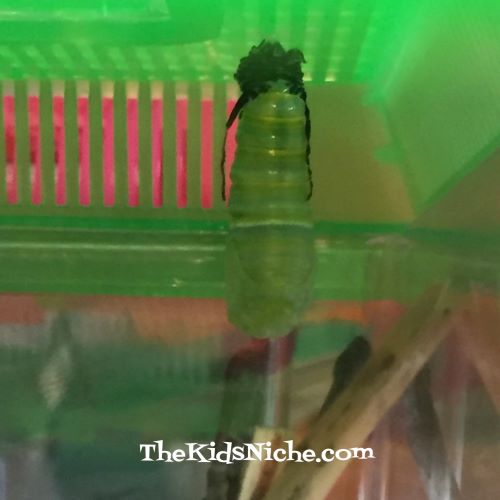
The split will get bigger and bigger and you will see more and more of the light green part appear.
Notice how the “skin” is getting all wrinkled up at the top.
Then finally, the bunch of old “skin” they don’t need anymore falls off.
They will wiggle around inside for a little bit and it will get shorter and shorter.
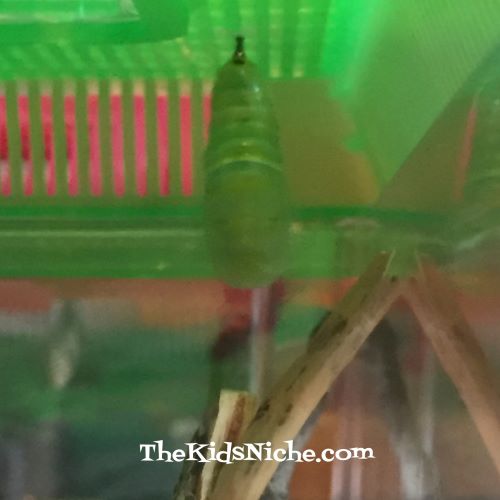
The rings at the top change and the chrysalis becomes smooth.
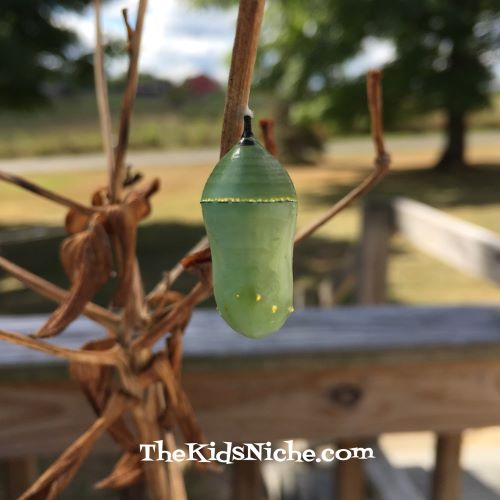
This is what a finished chrysalis looks like. Notice the gold dots and the gold line. Isn’t it amazing that a caterpillar made that??
The caterpillar is inside the chrysalis now and will be there for around 1 to 2 weeks. You won’t see much happening for a while but a wonderful, amazing transformation is taking place inside! I’ll share another post later of what happens when it’s time for the Monarch butterfly to emerge!
Yep, it’s begun again! In case you haven’t followed me long enough to know what I’m talking about, every summer I raise Monarch butterflies and release them back into the wild. The Monarch butterfly population had dwindled down drastically, but over the last couple of years the population has increased a LOT! Which is so exciting!! Many people are doing their part to grow plants that the Monarch’s feed on. Monarch caterpillars will only eat Milkweed plants. I look for the Monarch eggs or caterpillars and raise them in a safe place away from many of the predators that will destroy them. Here’s the start of my setup this year!
Last Sunday morning, I found 6 caterpillars and put them into their “hotels”. 😉 Some children were here that day and they discovered 5 more! And we were off and running! 🙂
I don’t put more than 4 caterpillars in one container at any given time. And I try to put the same sized caterpillars together.
Today I found 1 more caterpillar and he/she is still very tiny! Can you find him/her in the next 2 pictures?
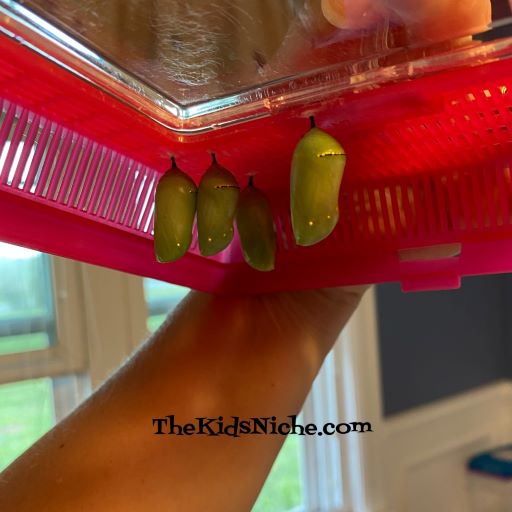
Isn’t that pretty neat?! I won’t share all the steps today that the caterpillar goes through to become a butterfly, but for now I’ll just say eventually they form a chrysalis. They stay in the chrysalis for a while and then the Monarch butterfly emerges. It’s truly magical! (I’ll share more details in another post.) Here is a picture of 4 of this year’s caterpillars that have gone into their chrysalis now:
For some reason, it seems they all wanted to be in the same corner of their hotel! LOL Two of them are actually touching, which I’ve never had happen before. Now the wait is on till it’s time for the butterfly to put in an appearance! I really enjoy raising Monarchs each summer! 🙂 It’s a great experience to share with your kids!
As you may have seen from my earlier posts, each summer I enjoy raising monarch butterflies. Their numbers have been drastically declining so I try to do my part in keeping them alive and well. Sometimes they make me laugh. Take the other day for instance…I was cleaning out their little “hotels” and so the lid was off. Some of the caterpillars I have at the moment had recently hatched so they are super tiny. Like this little guy…
He looks like he’s making a break for freedom! In less than a minute, he was all the way up here!
I could just imagine him saying, “YES! I’ve made it to the top and here I come big world!” 🙂 But the big human was watching. I grabbed a milkweed leaf and held it in front of him. He wasn’t too sure he wanted to get on the leaf but he finally did. Gotcha, little dude!
I looked away for a few seconds and when I looked back this is what I saw…
You sneaky little caterpillar! Where did you go?? Get back here! Guess where I found him? Look at the next picture and see…
Yep, he was hiding on the backside of the leaf! 😉 There were 10 little guys in that “hotel”, so I had to go on a hunt to find them all. Let’s see…we’ve now got #2 and #3…
There’s #2 through #7…
Added in #8 and #9…
Where in the world is #10 hiding?? OH, there he is! 🙂 Hiding on the bottom side of a milkweed leaf again!
Found them all! It can be hard but still fun when trying to spot all the little caterpillars. I guess I need to invest in a magnifying glass! 😉
It’s that most wonderful time of the year again! No, I’m not talking about Christmas. It’s the time of year when the Monarch butterflies have come back into the United States from wintering over in Mexico. The females are laying eggs on their favorite plants and people all over are doing their part to help the Monarch caterpillars survive to become butterflies. The number of Monarch butterflies has greatly declined over the last decade. It’s a great feeling to know you are helping to preserve these beautiful butterflies! And so, let’s take a peek at how the process gets started. Monarchs like the Milkweed plants and the female Monarch butterflies will lay their eggs on Milkweed. Here are a couple types of Milkweed that grow around where we live in Ohio.
Common Milkweed. This plant will grow wild along roadsides and its fun to watch as you travel around and see how many Common Milkweed plants you can find.
Swamp Milkweed. This plant I purchased from a greenhouse and planted in my flowerbed in hopes of bringing the Monarch butterflies close by where we could see and help them.
Butterfly Milkweed. This plant I also bought at a store and planted in my flowerbed in hopes of drawing the Monarchs here. Aren’t the little orange flowers so pretty?
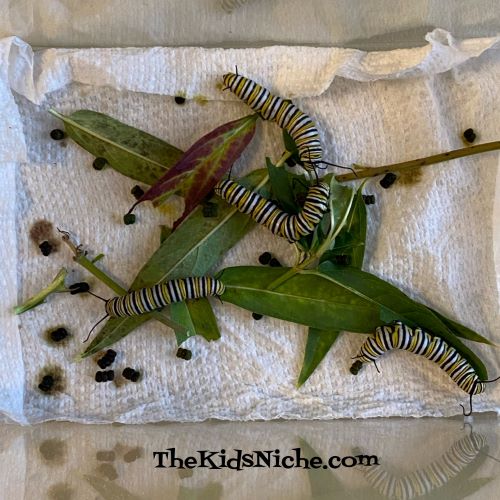
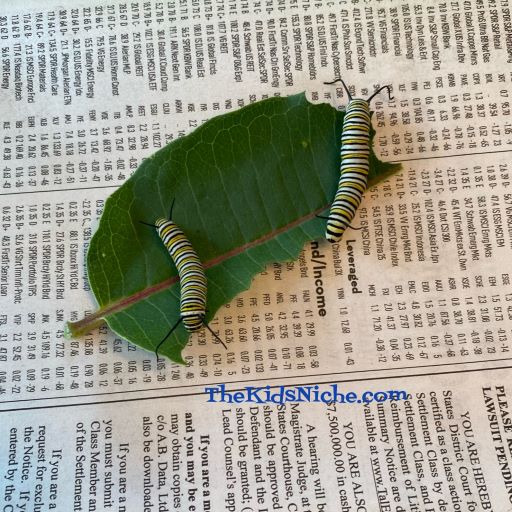
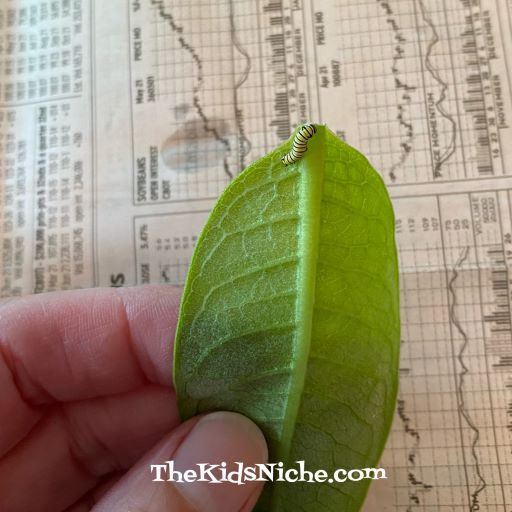
When you see these types of milkweed plants, look at the leaves and see if you see any Monarch caterpillars crawling around on them. They are often on the under side of the leaves. What does a Monarch caterpillar look like? Here is a picture of some Monarch caterpillars that are partially grown.
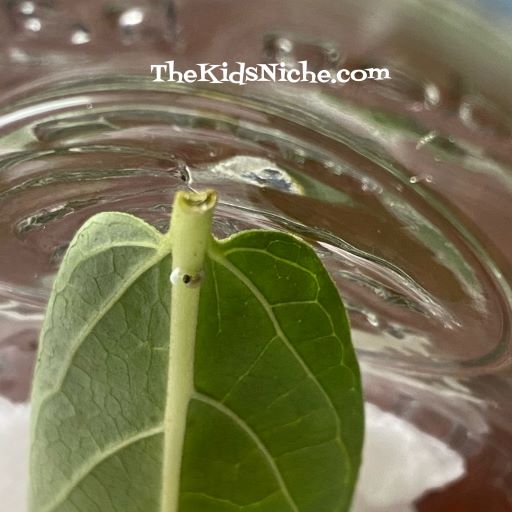
But I’m getting the cart before the horse! Whoa, back up there! When you see milkweed plants, not only should you look for the Monarch caterpillars, but you should look for their eggs. They are usually on the bottom side of the leaves too. They are super tiny so they are easy to miss seeing. Can you find the egg in this picture?
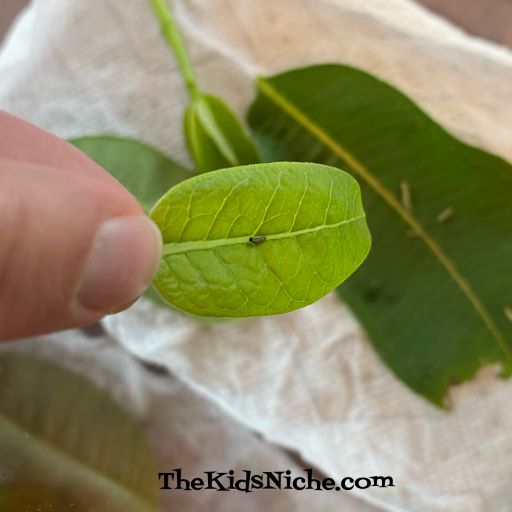
Yep, that little dot on the leaf over on the left hand side of the picture is a Monarch caterpillar egg. 🙂 We’ll call the egg the first step in the process. So the next step is when the egg hatches. The caterpillar that hatches from that tiny egg is so small it can be very hard to see it. I tried to take a close up picture of one that had just hatched. It’s rather hard to make it out, but that black dot is the caterpillar’s head.
The baby caterpillar will first eat the egg it hatched from and then they will look around for some milkweed to munch on. Milkweed is the only plant that a Monarch caterpillar will eat. There are 4 caterpillars in this next picture. Can you find all 4? 2 of them are super little! The other 2 have been around for a few days.
Here is another picture of a caterpillar that is really small, but bigger than the newly hatched ones. You can also see 3 more caterpillars that are older.
So now you know what plants to look at to see if you can find any Monarch caterpillars or eggs. And you know how super super tiny they are when they hatch. We’ll take a look at watching them grow on another day’s blog post. Happy hunting! 🙂
Hello and welcome to another adventure in the life cycle of the Monarch butterfly! Last week we looked at how the Monarch caterpillar changes into its chrysalis. Today we’ll see what happens when it’s time for the butterfly to emerge from the chrysalis. (Hang on until the end of this post for the video!) So just to remind you, here’s what the Monarch butterfly’s chrysalis looks like.
When the time for the butterfly to emerge is getting close, the chrysalis will start to turn a darker color and look black. Notice in this picture that one chrysalis looks green but the one in the background is black.
Here is a closer look.
Did you notice that you can see the butterfly’s wing inside the chrysalis? My pictures aren’t super clear because they are taken looking through the plastic container, but here is a picture taken with a flashlight shining on the chrysalis.
Whoa!! How cool is that?! The chrysalis is now very thin and you can see the butterfly! Next, the chrysalis starts to slowly open. Can you see along the left hand side that the chrysalis is splitting open?
Then the split becomes a little wider. The butterfly is hanging upside down right now and you can start to see its head coming out first.
The butterfly is dropping down a little lower now. You can start to see its legs that are folded up close to its head.
It’s now beginning to slide out of the chrysalis!
Sliding farther out…almost there! The chrysalis will stay attached to the top of the container as the butterfly slides down and out of it.
And it’s out! Look how big it’s body looks right now and how small and folded up it’s wings are.
The butterfly grabs a hold of the empty chrysalis and it will hang right side up now.
As the butterfly hangs on the chrysalis, it will pump fluid into its wings and the wings will begin to expand and the body will become smaller. This next picture was taken 5 minutes after the butterfly emerged or eclosed. Its wings are still wrinkled looking.
Then 10 minutes…it’s wings are looking straighter.
And then here is 15 minutes after emerging.
It takes a couple of hours for the butterfly to finish this process and for it’s wings to expand and dry off. They don’t need to eat right away so it’s good to give them time to dry off and to begin to flex their wings. After a few hours have passed, I carefully open the container and put my hand close to the butterfly and they usually climb onto my finger. And then it’s time to set them free outside.
Here is a video I took of the process of the butterfly emerging from it’s chrysalis. It is so amazing to watch this happen!
It has been such a rewarding experience for me to help these beautiful creatures along in their transformation from a tiny little egg into an amazing gorgeous butterfly! This is my second year of raising and releasing Monarchs and I hope I can continue to do so for many years to come! I hope you have enjoyed coming along with me on this journey! 🙂




























 The Kids Niche